As implementation continues for the New Energy Vehicle Industry Development Plan (2021–2035) (General Office of the State Council [2020] No. 39), issued by the General Office of the State Council, demonstrating confidence and determination in the development of new energy vehicles, local governments across China have successively issued detailed plans for electric vehicle charging infrastructure.
November 2020
|
General Office of the State Council
|
New Energy Vehicle Industry Development Plan (2021–2035) (General Office of the State Council [2020] No. 39)
|
August 2021
|
Shanghai Municipal Transportation Commission
|
Shanghai 14th Five-Year Plan for the Development of New Energy Vehicle Charging and Battery-Swapping Facilities (Draft for Public Comment)
|
December 2021
|
Guangdong Provincial Energy Administration
|
Guangdong Province 14th Five-Year Plan for the Development of Electric Vehicle Charging Infrastructure
|
May 2022
|
General Office of the Shanghai Municipal People’s Government
|
Implementation Opinions on Further Advancing the Construction of Charging and Battery-Swapping Infrastructure in Shanghai
|
June 2022
|
General Office of the Suzhou Municipal People’s Government
|
Suzhou 14th Five-Year Plan for Public Electric Vehicle Charging and Battery-Swapping Facilities
|
August 2022
|
August 2022
Beijing Municipal Commission of Urban Management
|
Beijing 14th Five-Year Plan for the Development of New Energy Vehicle Charging and Battery-Swapping Facilities
|
August 2022
|
Shanghai Municipal Transportation Commission
|
Shanghai Transportation Development White Paper (2022 Edition)
|
October 2022
|
Department of Industry and Information Technology of Hunan Province
|
Hunan Province Automotive Industry Development Plan (Hunan Industry and Information Technology Equipment [2022] No. 478)
|
Against the backdrop of China’s dual-carbon goals and the continuing effects of the post-pandemic era, the new energy vehicle industry continues to grow rapidly and remains a bright spot in the domestic economy. The New Energy Vehicle Industry Development Plan (2021–2035), issued by the General Office of the State Council, sets the direction for new energy vehicles over the next 15 years. The detailed electric vehicle charging infrastructure plans released across China provide further momentum.
01—State Council:
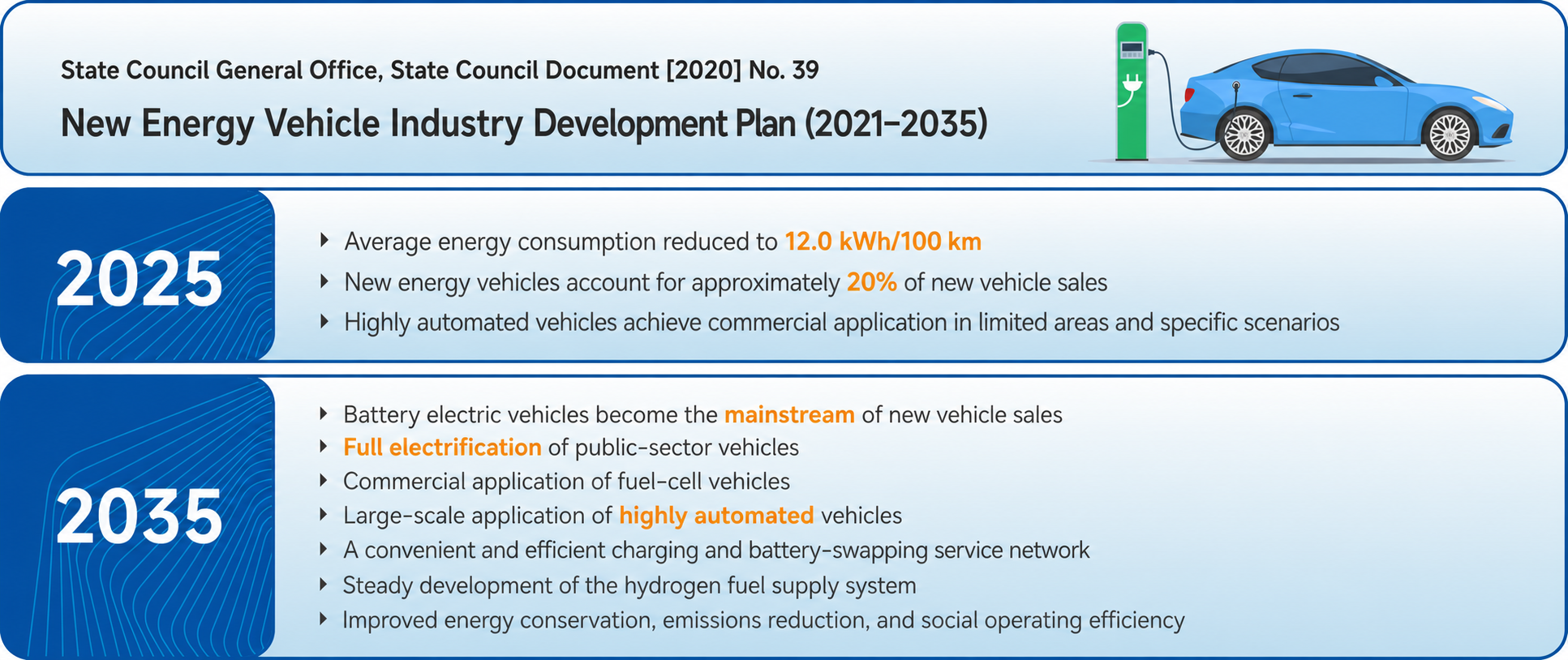
By 2025, the average energy consumption of new battery-electric passenger vehicles will fall to 12.0 kWh/100 km, sales of new energy vehicles will account for approximately 20% of all new vehicle sales, highly automated vehicles will achieve commercial application in defined areas and specific scenarios, and charging and battery-swapping services will become significantly more convenient.
Through 15 years of sustained effort, China aims to bring its core new energy vehicle technologies to an internationally advanced level and make its product quality and brands strongly competitive worldwide. Battery-electric vehicles will become the mainstream of new vehicle sales; vehicles used in public services will be fully electrified; fuel-cell vehicles will achieve commercial application; highly automated vehicles will be deployed at scale; charging and battery-swapping service networks will be convenient and efficient; and the hydrogen fuel supply system will advance steadily, effectively improving energy conservation and emissions reduction and the efficiency of social operations.
02—Beijing:
By 2025, Beijing will have essentially established a charging and battery-swapping infrastructure system aligned with the development of 2 million new energy vehicles, featuring efficient and orderly facility utilization, integrated cross-department collaboration, and digital and intelligent industry upgrades. This will be reflected in the following ‘three systems’:
1. Establish a citywide facility network supporting the charging and battery-swapping needs of 2 million new energy vehicles.
In overall scale, by the end of the 14th Five-Year Plan period, Beijing will aim for a total of 700,000 charging points, including 570,000 private and shared charging points in residential communities, 50,000 charging points within organizations, 60,000 public charging points, and 20,000 dedicated commercial charging points, together with 310 battery-swapping stations.
In service radius, by the end of the 14th Five-Year Plan period, Beijing will establish a public charging network in which users can find a charging point within 3 km in the city’s plains and within 0.9 km in core urban areas, making charging points easy to find and use. The average service radius for battery swapping will be less than 5 km.
In charging mix, by the end of the 14th Five-Year Plan period, the ratio of public fast-charging to slow-charging points will be no less than 2:1 in central urban areas and no less than 1:2 in other areas.
2. Build an efficiency-first service system that meets charging and battery-swapping needs across different fields and supports service improvements.
3. Create a collaboratively developed industry ecosystem that enables sustainable business model innovation and effective shared governance.
03—Shanghai:
1. By 2025, approximately 605,000 standard charging points will be installed citywide to meet the charging needs of 1.25 million new energy vehicles, with the vehicle-to-charging-point ratio maintained at no more than 2:1.
2. Approximately 530,000 private standard charging points will be installed to meet users’ basic charging needs.
3. Approximately 35,000 dedicated standard charging points will be installed for buses and coaches, logistics, sanitation, organizational and government vehicles, and other uses. In addition, 200 bus parking facilities and stations with charging capabilities and 45 taxi charging demonstration stations will be built to meet basic industry charging needs.
4. Approximately 40,000 urban public standard charging points will be installed to meet users’ temporary charging needs. Approximately 6,500 urban public charging stations will be built, including 250 large public fast-charging sites with ≥20 fast-charging units, to meet public-site service coverage requirements.
5. The intercity charging network will be improved. Each expressway service area will have at least eight public standard charging points. Public fast-charging facilities will be encouraged along national and provincial highways and at qualified gasoline and natural gas stations to meet cross-regional travel needs.
6. Approximately 300 electric vehicle battery-swapping stations will be built to meet the battery-swapping needs of branded passenger vehicles, taxis, logistics vehicles, heavy-duty trucks, and other vehicles.
7. Intelligent and orderly charging will be developed, with a target capacity to coordinate charging for 500,000 vehicles and 500,000 kW.
04—Guangdong:
By the end of 2025, Guangdong Province will have built more than 4,500 centralized charging stations and approximately 250,000 public and dedicated charging points in total, including approximately 217,000 public charging points and 33,000 dedicated charging points. Approximately 830 expressway fast-charging stations will have been completed, and charging infrastructure will cover all expressway service areas in the province. The service radius of charging facilities in core urban areas will not exceed 0.9 km in the Pearl River Delta or 2 km in the eastern, western, and northern regions of Guangdong. The ratio of public charging points to vehicles will be approximately 1:6.4.
05—Suzhou:
By 2025, Suzhou is expected to have built a cumulative total of 200,000 charging points, including no fewer than 155,000 private charging points, approximately 36,000 public charging points, and approximately 9,000 dedicated charging points. The city will have 1,843 public charging stations.
Based on the average investment cost of charging facilities in the city, excluding supporting costs for external power-grid connections, approximately RMB 6 billion will need to be invested in charging and battery-swapping facilities during the 14th Five-Year Plan period to meet the targets in this plan. This includes approximately RMB 2.7 billion for public charging facilities, RMB 700 million for dedicated charging facilities, RMB 600 million for battery-swapping stations, and approximately RMB 2 billion for private charging facilities.
Charging Safety
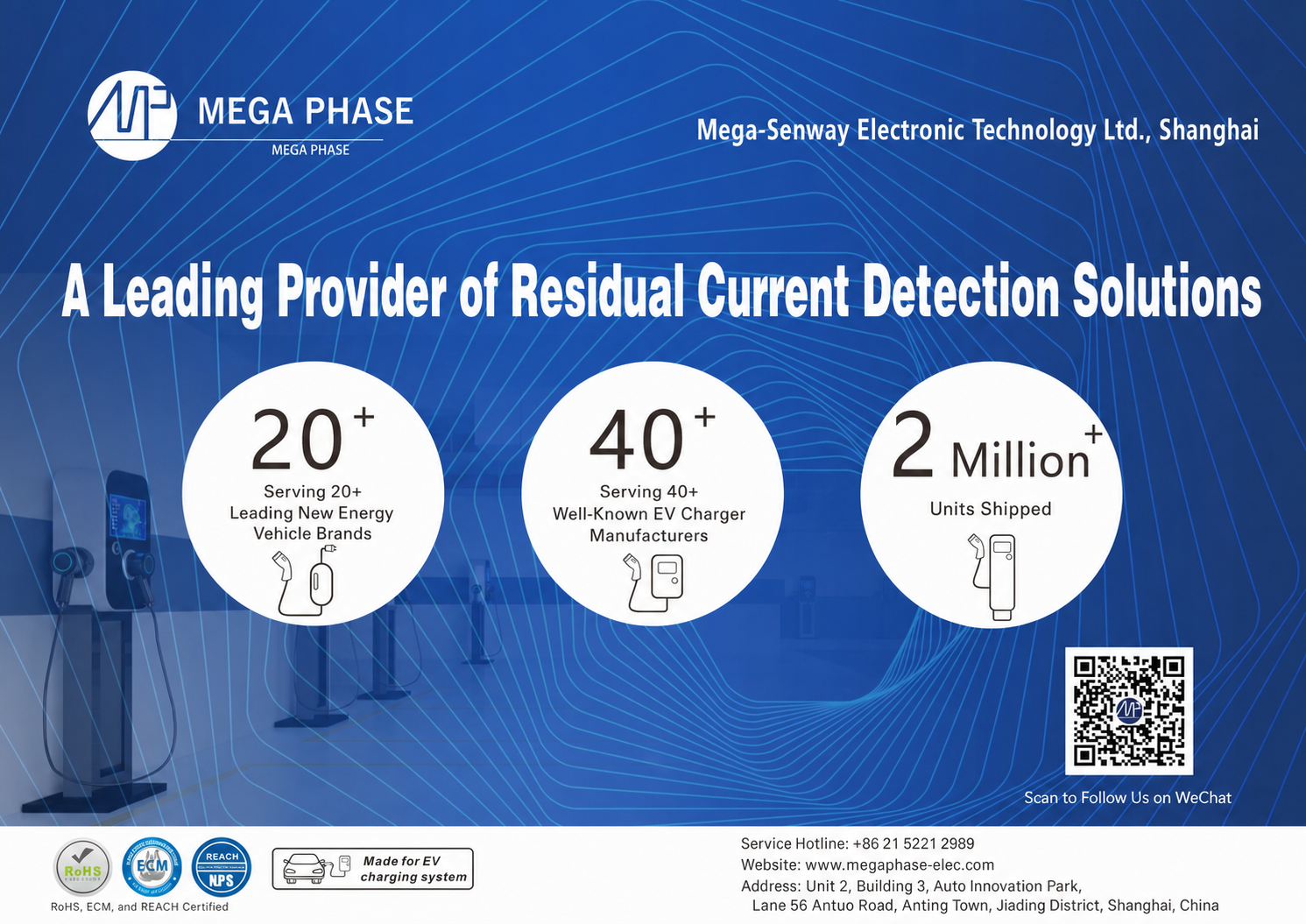
As new energy vehicles and charging points become more common and charging facilities become part of everyday life, safety is increasingly important. The independently developed MastCurr® Series residual current detection modules from Mega-Senway Electronic Technology Ltd., Shanghai (Mega-Phase) are based on the magnetic modulation principle and specialized algorithms for identifying residual current waveforms. Highly integrated, accurate, reliable, sensitive, modular, and customizable, they support charging-point detection solutions for multiple residual current types, including AC, pulsating DC, smooth DC, two-phase rectified, three-phase rectified, and multi-frequency composite waveforms. The detection module meets the latest European, Chinese, and U.S. standard requirements and supports intelligent AC charging points with Type A + DC 6mA smooth DC or Type B residual current protection, helping safeguard the development of new energy vehicle charging and battery-swapping infrastructure in China and overseas.
Related information:latest charging-point policies, Type B leakage current, Type B residual current, IC-CPD, A+6 leakage current, A+6 residual current, MC00, Type B, European-standard residual current protection, U.S.-standard residual current protection, onboard leakage current detection